The Three Voices of Technical Research: Why My Blog Sounds Nothing Like My Paper

Someone recently asked me a question that I've been thinking about ever since: "Doesn't writing your blog posts with humor and sarcasm undermine your credibility as a researcher?"
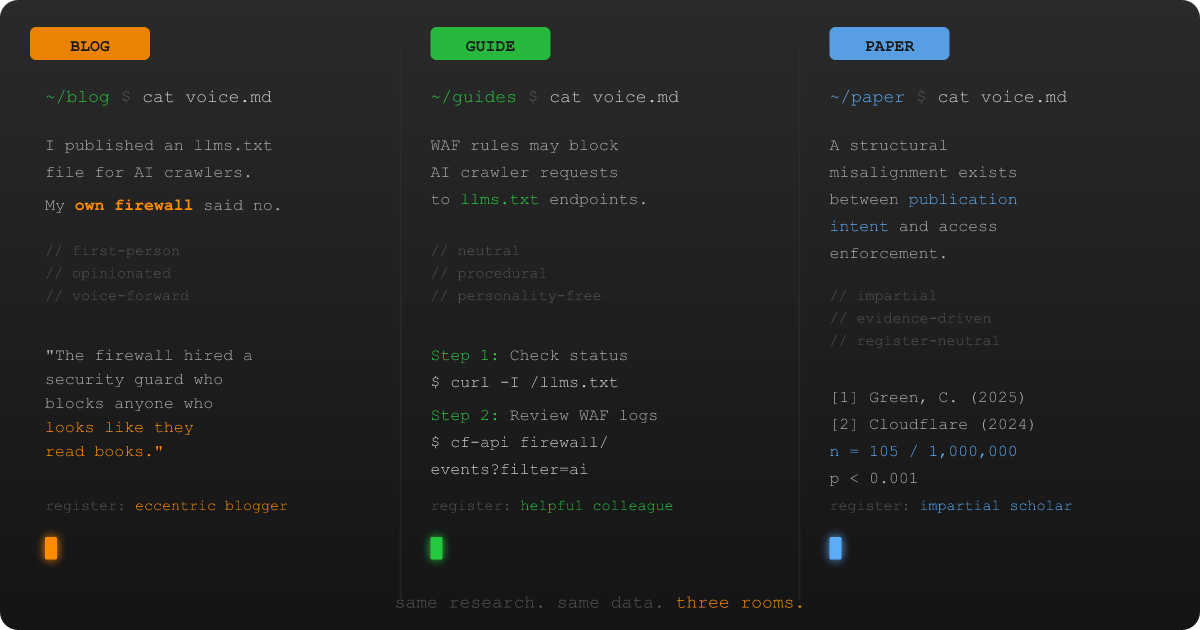
It's a fair question. The blog posts on this site are... aggressively me. I compare WAF blocking to "hiring a security guard who prevents anyone matching the physical description of 'reads books' from entering the bookstore." I describe AI crawlers as looking like "a DDoS attack with a liberal arts degree." I write sentences like "I am a documentation-first developer with a research compulsion and a growing collection of Markdown files about Markdown files," and then I publish those sentences on the internet where potential collaborators can see them.
Meanwhile, the analytical paper I'm writing about the same research uses phrases like "the structural misalignment between content publication intent and infrastructure-level access enforcement." Which is the same observation as the bookstore metaphor, expressed in the register of someone who wants to be taken seriously at a conference.
Same research. Same data. Same conclusions. Radically different voices. And I'd argue that if I used only one of those voices everywhere, the whole project would be worse.
The Three Layers
The llms.txt research project publishes through three distinct content types. Each has a different voice, a different audience, and a different job to do. I designed it this way on purpose, and the architecture is the most important editorial decision I've made on this project.
Layer 1: The blog posts. First-person, opinionated, voice-forward. This is where I tell the story of the research. The discovery at 11 PM on a Tuesday. The adoption stat that fell apart under scrutiny. The 78.8% of my own tool that turned out to be invented (context on that particular adventure is coming in my next post). The blog exists to make you care about a topic you didn't know existed. It does this by being human about it—admitting frustration, finding absurdity in technical failures, treating the reader as a co-conspirator rather than a student.
The blog voice is mine. The sarcasm is real. The parenthetical asides are how I actually think. The passion for documentation that permeates every post is not performed. I read spec documents recreationally. I understand that this is unusual. I have stopped apologizing for it.
Layer 2: The technical guide. Neutral, procedural, audience-agnostic. The WAF-AI Crawler Interaction Guide covers the same WAF blocking problem as the blog posts, but it's written for someone who has a specific problem and needs specific steps. No stories. No metaphors about bookstores. No parenthetical confessions about my emotional relationship with HTTP status codes. Just: "here's what's happening, here's how to check, here's how to fix it."
The guide voice is intentionally personality-free. Not lifeless—there's still a human behind it—but the register is "knowledgeable colleague walking you through a process," not "eccentric blogger ranting about firewalls." Someone dealing with WAF blocking at 3 AM doesn't need my humor. They need a curl command and a Cloudflare dashboard path.
Layer 3: The analytical paper. Impartial, evidence-driven, register-neutral. "The llms.txt Access Paradox" paper examines the same problems, cites the same data, and reaches the same conclusions as the blog posts and the guide. But it does so in the register of academic discourse: third person where possible, hedged where appropriate, meticulously sourced, and structured for a reader who is evaluating the research on its merits rather than being entertained by the journey.
The paper doesn't contain the phrase "I said words I can't publish on a professional blog." It doesn't need to. Its job is to establish that the infrastructure paradox exists, quantify it, contextualize it within the broader standards landscape, and propose constructive directions. Readers who engage with the paper are evaluating the argument, not the author. The voice steps aside so the evidence can speak.
Why Not One Voice?
Here's the argument I hear against this approach: "Just pick a register and stick to it. Audiences will figure it out."
I think that's wrong. It's wrong in a way that hurts accessibility and credibility.
Make the paper sound like this blog, and no peer reviewer will take it seriously. They'll see the sarcasm and conclude it's opinion. Doesn't matter that the data is solid, the evidence inventory is meticulous, and the methodology is rigorous. The packaging signals "blog post with delusions of grandeur," and people leave before they evaluate the substance.
Make everything sound like the paper, and you lose the 90% of readers who will never voluntarily open an academic document on a Monday morning. The WAF paradox is a genuinely interesting story about infrastructure and unintended consequences. Told as a story, it reaches people who would never have encountered the formal research. Those people are now aware of a problem they didn't know they had. That has real value. The paper alone would sit in an archive.
Make everything sound like the guide, and you lose both the story that draws people in and the rigor that makes findings citeable. Guides answer "how." They rarely ask "why" or "what does this mean for the broader ecosystem." Practical, yes. Limited, also yes.
The three-layer approach means each format can do its job without undermining the others. The blog hooks people. The guide helps them fix things. The paper gives them something to cite. Cross-links between layers handle the rest.
The Evidence Standard Scales Too
Voice isn't the only thing that varies. The three layers have different evidence standards, and being explicit about that is what makes the whole structure honest.
The paper's standard is strict: every factual claim maps to a verified primary source in the evidence inventory. Claims that can't be independently verified get cut. The unnamed hosting provider from Yoast's analysis? Gone from the paper. Anonymous secondhand attribution doesn't survive peer review.
The blog's standard is looser but still sourced. (I'm not reckless.) The same Yoast hosting provider claim appears in Part 2, but with an explicit caveat: "though the provider wasn't identified, so the attribution chain is thin." Readers get the data point and the context to evaluate it. The paper can't make that trade-off. The blog can.
The guide doesn't care who published the research. It cares whether the information is actionable. The guide links to Cloudflare's documentation because practitioners need to know which dashboard panel to click, not which researcher first documented the execution order.
These aren't compromises. They're editorial decisions, documented in the evidence inventory.
The Credibility Question, Revisited
So: does the blog voice undermine research credibility?
I think the answer is no, because credibility doesn't live in the tone. It lives in the methodology, the evidence, the transparency about what's verified and what isn't, and the willingness to correct errors publicly. My paper's credibility comes from its 49-claim evidence inventory, its 33 verified sources, its two publicly acknowledged corrections, and its documented editorial decisions. The blog's sarcasm doesn't touch any of that.
What the blog voice does is make the research accessible to people who wouldn't otherwise engage with it. The person who clicks on "I Tried to Help AI Read My Website. My Own Firewall Said No" might not click on "The llms.txt Access Paradox: Infrastructure-Level Barriers to AI Content Discovery." But both lead to the same research, the same data, and the same conclusions. The blog is an on-ramp. The paper is the destination. The guide is the service road for people who just need to get somewhere specific.
Different roads. Same city. That's the architecture.
The Part Where I Admit This Is Also Just Who I Am
I should be honest about something: the three-layer architecture isn't purely strategic. Part of it is that I genuinely cannot write in one register all the time.
The blog voice is how I think. The extended metaphors, the parenthetical confessions, the slightly manic enthusiasm for Markdown files about Markdown files—that's not a persona. That's me, poorly socialized for academic discourse and aware of it. If I forced every piece of writing through the paper's register, I'd lose the thing that makes the writing mine. If I forced everything through the blog's register, I'd get the paper back with "interesting findings, inappropriate tone, please revise" scrawled across the top.
The three-layer architecture lets me be honest about all of it: the researcher who verifies every claim, the practitioner who documents every solution, and the writer who thinks that WAF rule execution order is both structurally important and cosmically funny. They're all the same person. They just write in different rooms.
If you're working on a research project that produces content for multiple audiences—and most projects should—consider giving yourself permission to use more than one voice. The research doesn't need protecting from your personality. It needs a personality to carry it to people who would benefit from it but will never read the paper.
Trust the evidence to establish your credibility. Trust the voice to establish your reach. And keep them in separate documents, because a research paper that contains the phrase "DDoS attack with a liberal arts degree" is not getting past peer review, and we both know it.