The Quiet Part
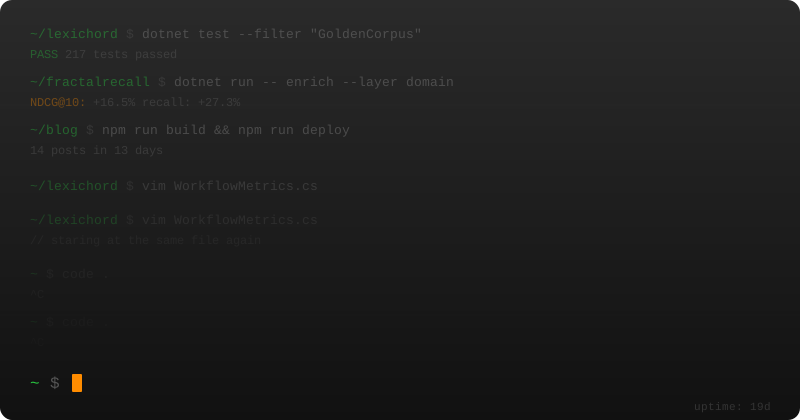

You may have noticed it got quiet around here.
No farewell post. No "exciting announcement." No carefully worded "I'm pivoting to..." thread with a blue-sky emoji. Just... silence. Three weeks of it, which in blog-time is roughly equivalent to leaving a shopping cart in the middle of the grocery aisle and walking out of the store.
I owe you an explanation. Or, more accurately, I don't owe you anything, but I'm going to give you one anyway because I spent the last three weeks staring at my projects and feeling nothing, and it turns out that's worth talking about.
The Wall
Burnout doesn't arrive like a deadline. It doesn't send calendar invites. It shows up like a slow leak in a tire; you don't notice it until you're standing in a parking lot wondering why everything feels slightly wrong and harder than it should be.
Here's what mine looked like: I'd open Lexichord. Stare at the code. Close the tab. Open FractalRecall. Read three lines of my own design spec. Close that tab too. Check my email. Make coffee. Open Lexichord again. Stare harder this time, as if intensity might substitute for interest. It didn't.
This went on for days before I admitted what was happening.
I wasn't stuck on a technical problem. I wasn't blocked by a dependency or a design flaw or a missing NuGet package. The projects were fine. I was the part that wasn't working.
What Burnout Isn't
I want to be precise about this because the internet has turned "burnout" into a catch-all for everything from genuine exhaustion to "I didn't feel like doing stuff this week." Those aren't the same thing. Laziness is a choice. Burnout is what happens when you've been making the opposite choice for too long.
Fourteen blog posts in thirteen days. Multiple research projects running in parallel. A benchmark methodology. A .NET library. An AI orchestration tool with a growing test corpus. A dungeon crawler because apparently my brain's idea of "relaxation" is modeling combat state machines.
None of that was forced on me. I loved all of it. That's the part nobody warns you about; the burnout you have to watch for isn't the kind that comes from doing work you hate. It's the kind that comes from doing work you love at a pace your brain can't sustain.
Sprinting is fine. Sprinting indefinitely is not a strategy.
The Permission Problem
There's this specific flavor of guilt that technical people carry around like a loyalty card they forgot to throw away. The project is interesting. The work is meaningful. Nobody's making you do it. So if you stop, what does that say about you?
It says you're a person with a nervous system. That's it. That's the whole answer.
But knowing that intellectually and feeling it are two different things. I spent the first week of this break doing the worst possible version of resting: not working on projects, but also not not thinking about them. Sitting on the couch with my laptop open to a file I refused to read, accomplishing the impressive feat of neither relaxing nor being productive. A perfectly balanced failure state.
Somewhere around week two, the guilt machinery finally ran out of fuel. I stopped opening the laptop. I played games that someone else designed. I read books that had nothing to do with embeddings or metadata or retrieval-augmented anything. I went outside, which I can report is still there and largely unchanged.
What I Learned (Sort Of)
I'm not going to package this up with a bow. I don't have a five-step framework for recovering from burnout, and if someone tries to sell you one, that person is selling you a content calendar disguised as therapy.
But I noticed some things.
The projects didn't collapse. Lexichord is right where I left it. FractalRecall's design spec didn't rewrite itself out of spite. The llms.txt research is still sitting in my evidence inventory, patient as ever, waiting for me to come back and ask it more questions I won't like the answers to.
Nothing caught fire. The world continued to not depend on my publishing schedule. This is both humbling and, in a quieter way, freeing.
I also noticed that the docs-first compulsion, the one that drives me to document everything before building it, applies here too. I couldn't just take a break. I had to understand why I needed one, what the failure mode was, and what the recovery criteria looked like. Yes, I am aware that analyzing your own burnout with the same rigor you'd apply to a design spec is itself a symptom. I contain multitudes. (And a changelog.)
What Happens Now
I'm back. Provisionally. Not at the pace I was running before, because that pace was the problem.
The projects haven't changed. The work is still interesting. What has changed is that I've given myself permission to not publish fourteen posts in two weeks and call that "normal." It was never normal. It was adrenaline masquerading as a workflow.
I'll be writing here again. Probably not daily. The llms.txt research still has findings worth publishing. Lexichord still needs its test corpus finished. FractalRecall still has an unresolved question about prefix artifact contamination that I think about in the shower. (This is not a metaphor. I literally think about embedding prefix artifacts in the shower. I may need additional hobbies.)
But the pace is going to be different, and I'm not going to apologize for that. Three weeks of quiet isn't a failure. It's what happens when someone who writes documentation about their documentation process finally admits that the documentation subject this time is themselves.
I'm still here. I'm still building.
I just needed to stop sprinting long enough to remember why I started running.